The scent of atomized sugar and scorching lipids hits your olfactory receptors before you even cross the threshold of the midway. This is not mere street food; it is a high-velocity study in fluid mechanics and thermal transition. We are here to master the Funnel Cake Flow. This specific phenomenon occurs when a non-Newtonian fluid meets a 375-degree oil bath, creating a chaotic yet structural lattice of golden-brown delight. To achieve the perfect specimen, one must understand the delicate balance between viscosity and gravity. If the batter is too thin, it disintegrates into greasy shrapnel; if it is too thick, it sits in the oil like a heavy, leaden brick. We are aiming for a crisp, airy architecture that defies the laws of caloric density. Strap in, because we are about to audit your kitchen infrastructure and overhaul your technique to ensure every pour results in a structural masterpiece of fried dough that would make a civil engineer weep with joy.
THE DATA MATRIX
| Metric | Specification |
|---|---|
| Prep Time | 15 Minutes |
| Execution Time | 5 Minutes per Unit |
| Yield | 6-8 Units |
| Complexity | 4 / 10 |
| Estimated Cost per Serving | $0.65 USD |
THE GATHERS
Ingredient Protocol:
- 300g / 2 cups All-Purpose Flour (High protein content preferred)
- 240ml / 1 cup Whole Milk (Room temperature for better emulsification)
- 2 Large Eggs (Approximately 100g)
- 50g / 1/4 cup Granulated Sugar
- 10g / 2 tsp Baking Powder (Check expiration for maximum aeration)
- 2g / 1/2 tsp Fine Sea Salt
- 5ml / 1 tsp Vanilla Extract
- 1 Liter / 4 cups Neutral Oil (Canola or Grapeseed for high smoke points)
- 50g / 1/2 cup Powdered Sugar (For the final aesthetic coating)
Section A: Ingredient Quality Audit:
If your flour feels clumped or damp, it has absorbed ambient humidity; sifting is non-negotiable to prevent gluten boulders in your Funnel Cake Flow. Sub-par baking powder is the leading cause of "dense-sinker" syndrome. To test, drop a pinch into hot water; if it doesn't fizz violently, discard it immediately. If using low-fat milk, the lack of lipids will result in a brittle, dry lattice. Fix this by whisking in 15ml of melted butter to the batter to ensure a tender crumb. Finally, ensure your eggs are not straight from the refrigerator. Cold proteins inhibit the batter from stretching properly when it hits the heat, leading to a fragmented structure rather than a continuous, winding rope.
THE MASTERCLASS
1. Dry Component Integration
Begin by whisking your flour, sugar, baking powder, and salt in a large stainless steel bowl. Use a digital scale for these measurements to ensure the ratio of starch to leavening agent is mathematically precise.
Pro Tip: Sifting your dry ingredients twice does more than remove lumps; it introduces micro-pockets of air that help the batter aerate instantly upon contact with hot oil. This is the foundation of a light, crisp texture.
2. Emulsifying the Wet Matrix
In a separate saucier or mixing bowl, vigorously whisk the milk, eggs, and vanilla. You are looking for a homogenous pale yellow liquid with no visible streaks of egg white.
Pro Tip: Using a saucier with rounded bottom edges prevents "dead zones" where unmixed egg can hide. Proper emulsification here ensures the fat from the yolk is evenly distributed, which prevents the final product from tasting overly oily.
3. Achieving the Golden Viscosity
Slowly pour the wet ingredients into the dry, whisking constantly from the center outward. The goal is a batter that mimics the consistency of heavy cream. It should coat the back of a spoon but still run freely.
Pro Tip: If the batter is too viscous, it won't exit the funnel at the correct velocity. Use a bench scraper to clean the sides of the bowl, ensuring every gram of flour is hydrated. Let the batter rest for 10 minutes to allow the gluten to relax.
4. Calibrating the Thermal Environment
Heat your oil in a deep, heavy-bottomed skillet until it reaches exactly 375 degrees Fahrenheit. Use an infrared thermometer to verify the temperature across the entire surface of the oil.
Pro Tip: Temperature stability is key. If the oil drops below 350 degrees, the dough will absorb grease rather than searing. A heavy cast-iron pan acts as a thermal heat sink, maintaining a steady temperature even when cold batter is introduced.
5. Executing the Funnel Cake Flow
Plug the end of your funnel with a finger, fill it with one cup of batter, and position it 4 inches above the oil. Move in a rapid, circular motion, overlapping the strands to create a unified lattice.
Pro Tip: The "flow" must be continuous to ensure structural integrity. If you stop and start, the cake will break into individual fries. Aim for a "controlled chaos" pattern that allows for maximum surface area, which optimizes the Maillard reaction.
6. The Flip and Recovery
Fry for 90 seconds until the bottom is a deep golden hue. Use two long metal spatulas or a specialized frying spider to carefully flip the cake. Fry for another 60 seconds.
Pro Tip: Remove the cake and place it on a wire cooling rack rather than paper towels. A rack allows air to circulate around the entire structure, preventing steam from softening the crisp exterior you worked so hard to build.
Section B: Prep & Timing Fault-Lines:
The most common human error is "The Hesitation." If you pour too slowly, the first strands will be overcooked before the last strands hit the oil. Practice your circular motion with water over a sink first to build muscle memory. Another failure point is oil recovery time. After removing a cake, wait at least 60 seconds for the oil to return to 375 degrees before starting the next unit. Rushing this step results in a soggy, pale mess.
THE VISUAL SPECTRUM
Section C: Thermal & Visual Troubleshooting:
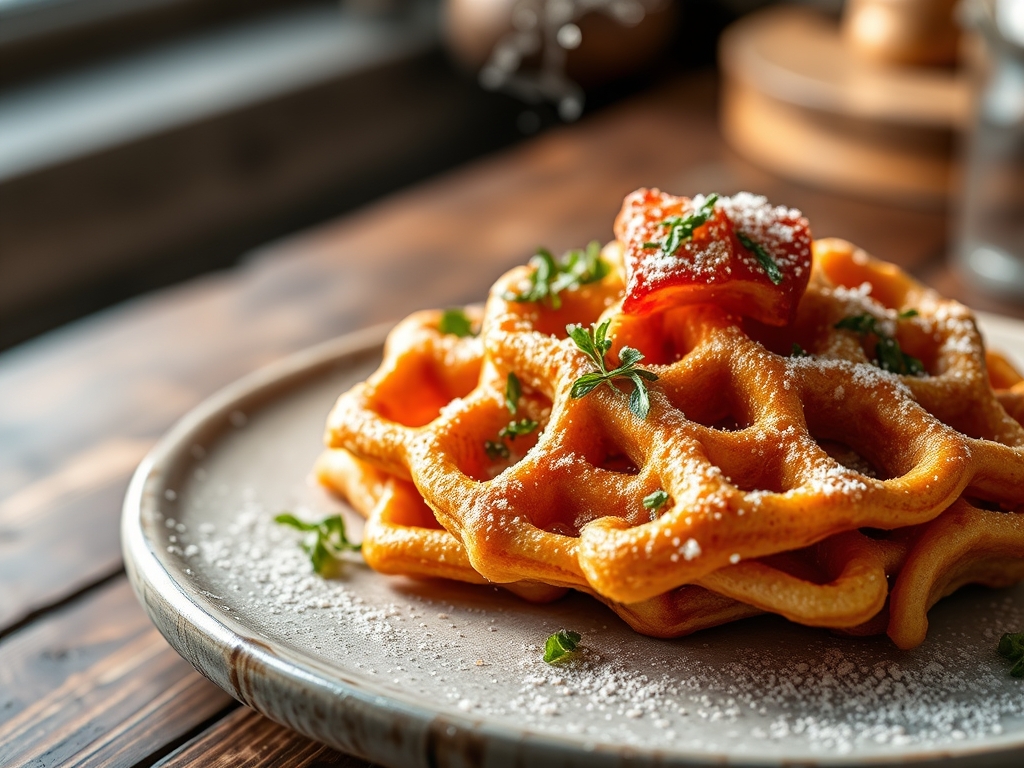
Look closely at the Masterclass photo. Notice the intricate, interconnected "ropes" and the high-contrast browning. If your cake looks like a solid pancake, your batter is too thick; thin it with a tablespoon of milk. If it looks like "popcorn" (small, disconnected beads), your oil is too hot or your batter is too thin. Dull, matte colors indicate old oil or a lack of sugar in the batter; sugar is essential for the caramelization that provides that iconic glow. If the center is doughy while the edges are burnt, your heat is too high; lower the flame and aim for a slower, more even render of the starches.
THE DEEP DIVE
Macro Nutrition Profile:
A standard funnel cake (approximately 150g) contains roughly 450-500 calories. The profile is dominated by carbohydrates (60g) and lipids (22g), with a modest protein contribution (8g). It is a high-glycemic index food designed for immediate energy expenditure.
Dietary Swaps:
- Vegan: Replace whole milk with oat milk (which has a similar sugar-to-fat ratio) and use a commercial egg replacer or "flax eggs."
- Gluten-Free: Utilize a high-quality 1-to-1 GF flour blend containing xanthan gum to maintain the necessary viscous stretch.
- Keto: This is a challenge, but almond flour combined with unflavored whey protein and erythritol can produce a "fried bread" effect, though the lattice structure will be more fragile.
Meal Prep & Reheating Science:
Funnel cakes are best consumed within the first 10 minutes of birth. However, to maintain molecular structure for later, do not microwave. Reheat in a 400-degree air fryer for 2 minutes. This flash-heats the surface lipids, restoring the "crunch" without drying out the interior crumb.
THE KITCHEN TABLE
Why is my funnel cake falling apart in the oil?
Your batter lacks structural tension. This usually happens if there isn't enough flour or if you didn't overlap the strands enough during the pour. Ensure you are creating a "web" that connects to itself in multiple places.
Can I use a squeeze bottle instead of a funnel?
Absolutely. A squeeze bottle offers superior control over the Funnel Cake Flow. Just ensure the nozzle opening is at least 1/2 inch wide; otherwise, the pressure will cause the batter to "mist" rather than flow in a rope.
What is the best oil for frying dough?
High-smoke point oils are mandatory. Peanut oil is the gold standard for flavor and stability, but Grapeseed or Canola work perfectly for a neutral profile that lets the sugar and vanilla shine through.
Why is my powdered sugar disappearing?
If you apply sugar while the cake is screaming hot, the residual steam will dissolve the crystals into a clear glaze. Wait 30 seconds for the surface to stabilize before hit it with a heavy snowstorm of sugar.